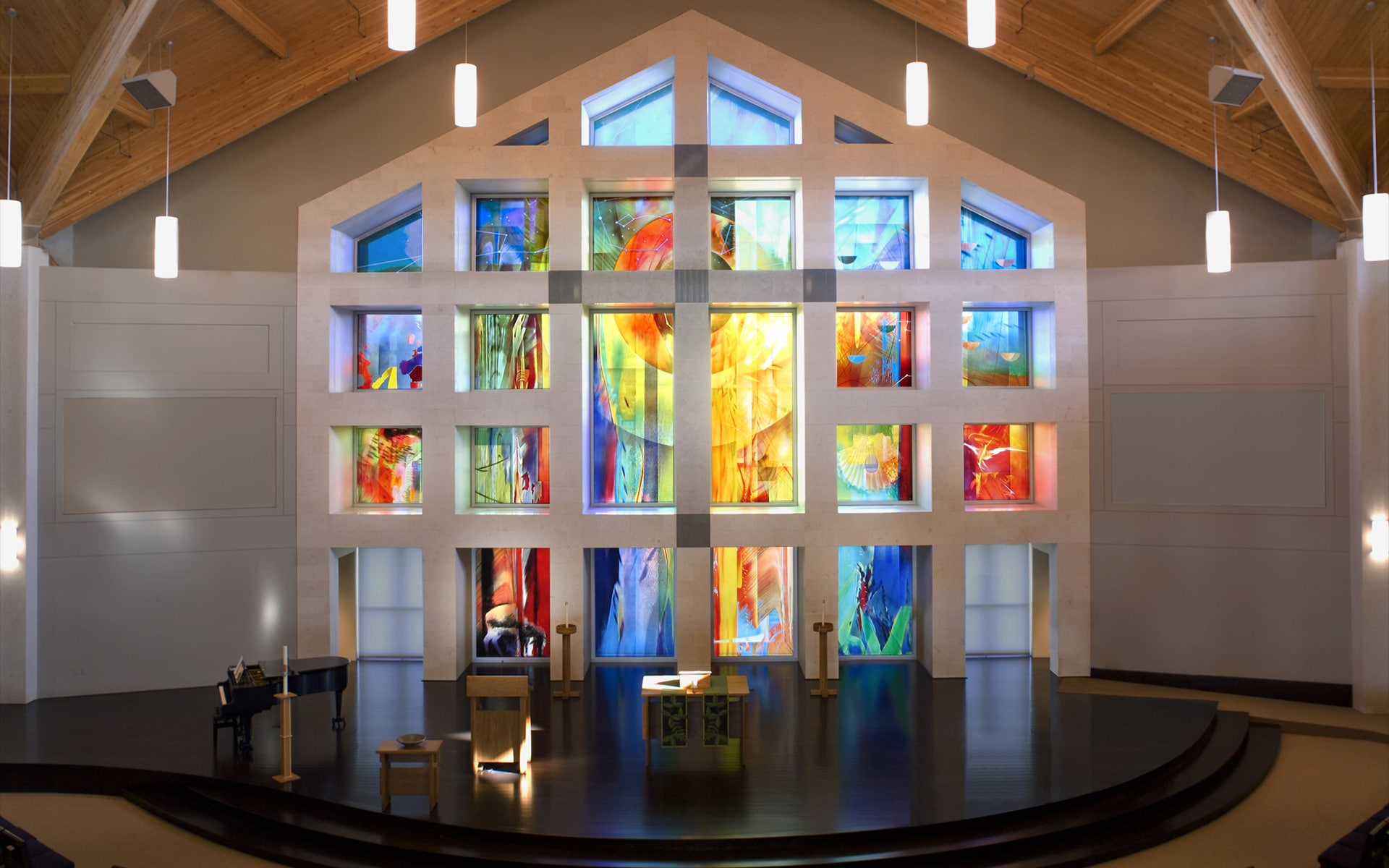
A stained glass commission is one of the most significant things a church community will ever undertake. Of all the materials a church is built from, only glass brings in light — and light, in a church, is theology. Glass is immediately felt and seen, present in every moment of worship, woven into the life of the church.
And glass is unlike any other material. Light does not pass through it so much as it is transformed by it — and what appears on the other side can feel like another world entirely. There is a threshold quality to glass that few materials possess, a presence that points beyond itself. The breath and hand of every maker are present within — the earthly and the luminous reconciled.
An engineer who had reasoned his way out of the possibility that stained glass could do anything was suddenly stopped one Sunday morning, unable to explain what he felt.
A community places a book of names in front of the Sister Death window — Francis’s last words, made luminous by glass that is mostly dark, deep blues and black, a single thread connecting the darkness to the light.
A pastor, with the light of an Easter dawn, pauses, and turns to the congregation, saying — look at those windows this morning — He is risen. He is risen indeed.
I am a painter who works in glass. My formation as an artist and as a person of faith are not separate things — both began early and have deepened together over a lifetime of making work for sacred spaces. That is what I bring to every commission, placed entirely in service of the community and its worship.
Working with Architects and Building Committees
This is how I enter a commission —
With a conversation. With listening. With the community’s faith as the starting point.
Stained glass can be part of a new building, a renovation, or a completion of something begun years ago when resources ran short. Whatever the circumstance, the work begins in the same place — with a community, and a conversation about who they are.
Projects often involve pastors, building committees, diocesan leadership, architects, and liturgical consultants — each bringing different priorities and responsibilities. My role is to listen carefully to all of it, and to translate what I hear into a unified visual language expressed through light and faith.
These are the kinds of questions I like to begin with:
Who are we as a community?
What distinguishes us?
What is the work we do in the world?
Is the name of the church or parish a primary consideration?
Is there a defining scripture?
What would you like to see?
What would you like to feel or think when viewing the glass?
How can the glass aid your worship and support the liturgy?
Scope
My commissions range from a single chapel window to a complete multi-window program for a new church. Stained glass can also go in doors, screens, baptisteries, and other architectural elements that deepen the experience of a sacred space.
Process
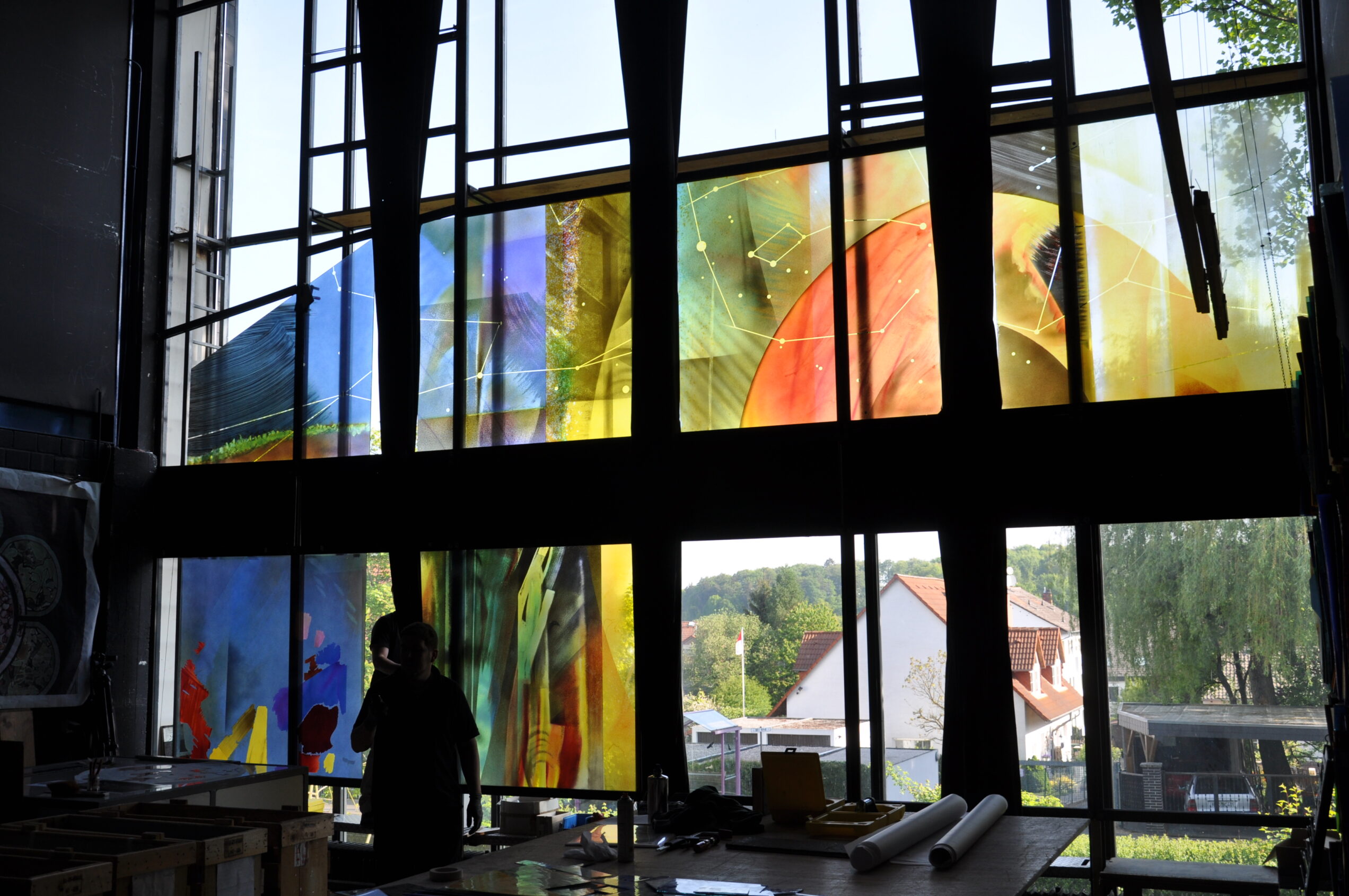
Initial concept designs typically offer one or two distinct directions. After feedback, reflection, and refinement, color, scale, and imagery are clarified into a final design to be approved.
Fabrication is realized in collaboration with Derix Glasstudios in Taunusstein, Germany, a five-generation studio I have worked with for nearly twenty years. Some committees have made the journey to visit during fabrication — to stand in the studio and watch the windows taking shape before they’ve seen the inside of their finished church.
Installation
Installation is carried out in close coordination with the building team and architect. On some projects I work with local glaziers; on others the studio travels to the site.
The Glass
Most people in the United States have never seen mouth-blown stained glass. What they know is machine-made — milky, flat, murky, industrial. What I work with is something else entirely.
Mouth-blown antique glass is the most beautiful material on the planet. This glass is jewel-like in a way that feels less like architecture and more like a vision — the walls of the New Jerusalem made present in light and color. When the sun shines through transparent glass, it can throw color across the full length of a church — deep reds and blues moving across floors and walls as the sun moves, breathtaking in a way no photograph prepares you for. It doesn’t block the view. It transforms it.
The opaque glass — what Germans call Opak — is equally extraordinary, and differently so. You cannot see through it. Instead it holds light within itself, setting an atmosphere, a presence, something close to mystery. There is no analogy for it. No other material does this. When the sun sets, this glass holds the last light of the evening and stays illuminated until there is no light left to hold.
The studio I work with has restored glass at the Strasbourg Cathedral — the largest cathedral in Europe for nearly four centuries — and installed contemporary windows in the Cologne Cathedral, the largest cathedral in Europe today. The material, the craftsmanship, the beauty — is world-class and amazing. There is nothing else like it.
Budget and Timeline
The cost of a stained glass commission depends on scale, complexity, and material. Every project receives a detailed quote that accounts for every aspect of the work, from design through fabrication and installation. I have never added charges beyond an accepted quote.
For many churches the design renderings developed during the early phase have proven to be among the most effective tools for a capital campaign — helping donors see exactly what is being created for their community. Most projects move from first conversation to installed glass within six to eighteen months.
For architects, I can work with any number of file types to provide renderings and light studies for season and time of day. All glass panels, whether integrated into IGUs or a separate panel, are tempered and engineered to meet building codes.
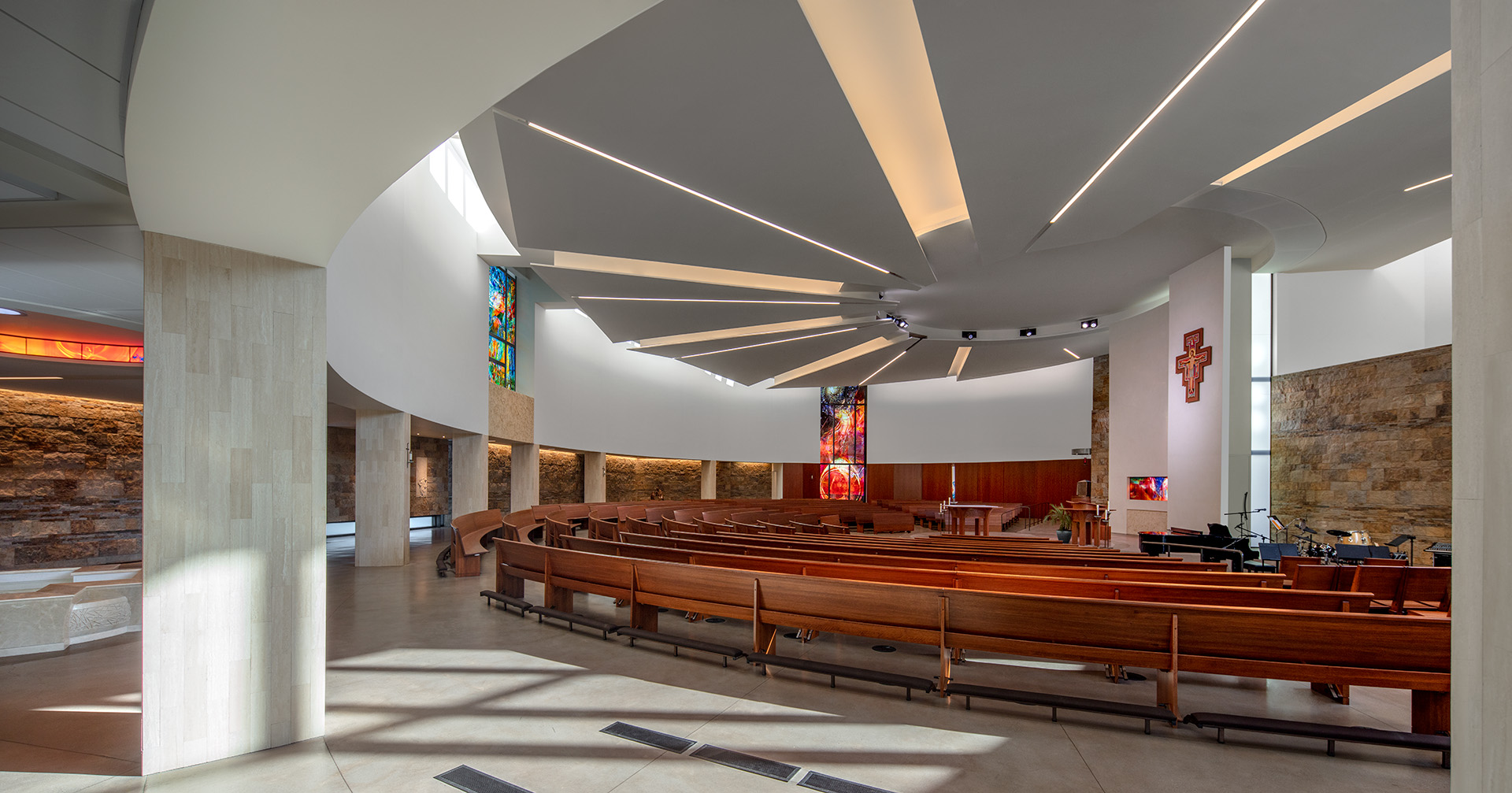
Case Study: Our Lady of the Angels, Scottsdale, Arizona
One commission, from first phone call to dedication.
I was at Dairy Queen with my family when the call came — a liturgical consultant reaching out about a new Franciscan church in Arizona. Nine windows. A building still being designed. And an invitation to come to Arizona and simply get to know one another.
I am a stained glass artist based in Sioux Falls, South Dakota, and my commissions have taken me across the United States and Canada. I am fluent in Spanish and welcome inquiries from Spanish-speaking communities. To see the full range of liturgical work, including stained glass, mosaic, and chapel commissions:
Begin a Conversation