A Stained Glass Case Study
I was at Dairy Queen with my family when the call came. A liturgical consultant reaching out about a new Franciscan church in Arizona — nine windows, a building still in design, a community with a clear and beautifully articulated vision for what they wanted the space to become. The timing was exactly right. Working alongside the architects as the building was still being designed allowed us to refine the placement and approach of a number of the windows — including the windows behind the altar, which evolved significantly through the dialogue between the glass design and the architecture.
The approach they took was the right one. They identified three artists beforehand — two sculptors and me for glass — and invited each of us to visit La Casa — the site, meet the Franciscan priests, the building committee, and the consultant. It was not an audition. It was a conversation, an opportunity to understand one another before any commitment was made. That kind of beginning makes everything that follows possible.
The art program developed by Capuchin friar Mark Joseph Costello, the liturgical consultant, with the church committee was one of the finest I have encountered — theologically rich, spiritually alive, and genuinely useful as a guide for the work ahead. I understood what was needed.
When I returned to present the first concepts, the room fell silent after I showed the Marian window. I wasn’t sure at first what that silence meant. Then the committee spoke — with emotion and conviction. They said they hadn’t known ahead of time what they were looking for, but when they saw it, they knew. That was the window. When I presented the Sister Death window, people in the room began to cry.
An architect on the committee wrote afterward: “Your art continues to take my breath away. You create such beautiful, dynamic, lyrical work. Thank you for your part in making beauty present.”
The Vision
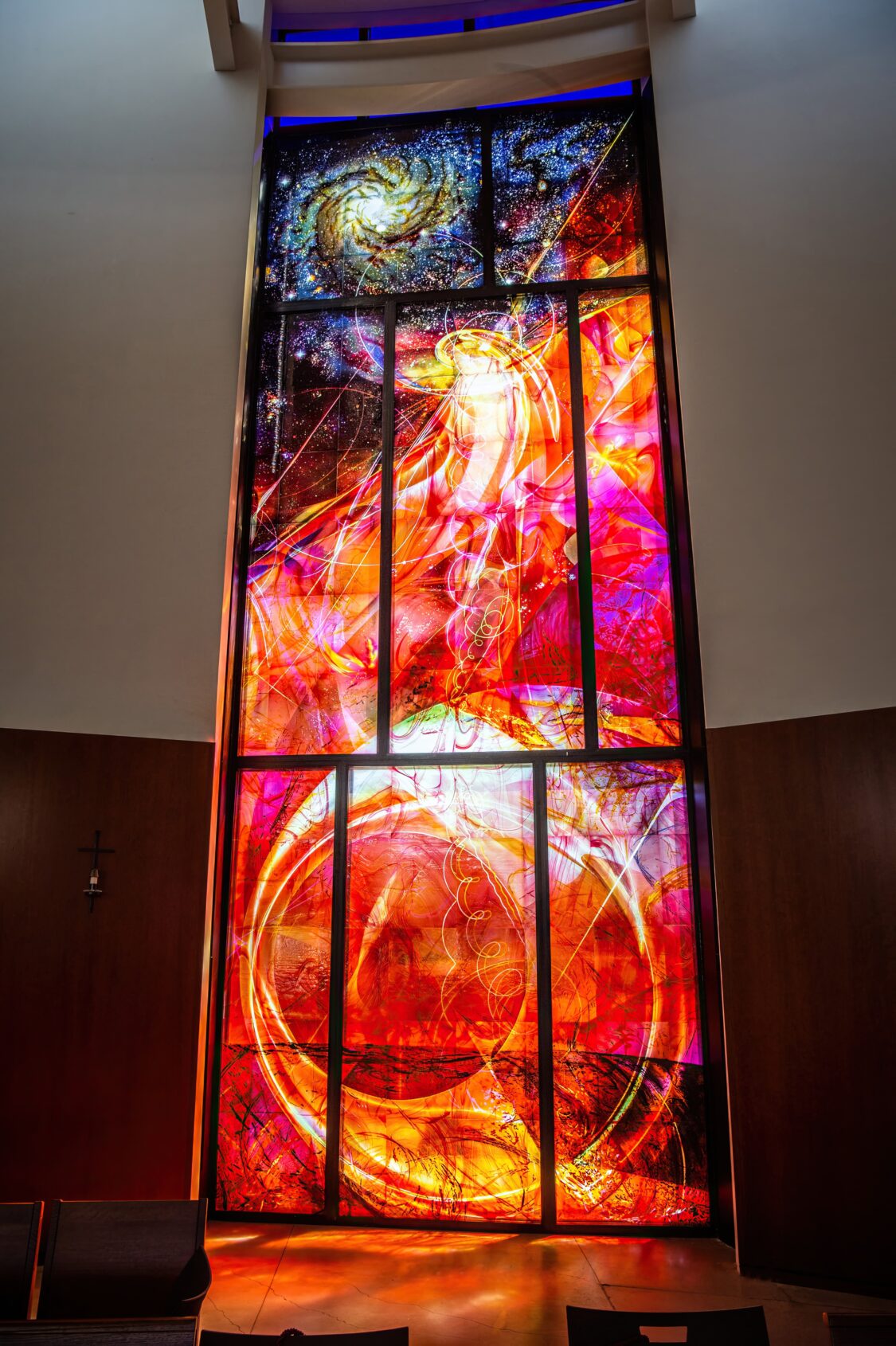
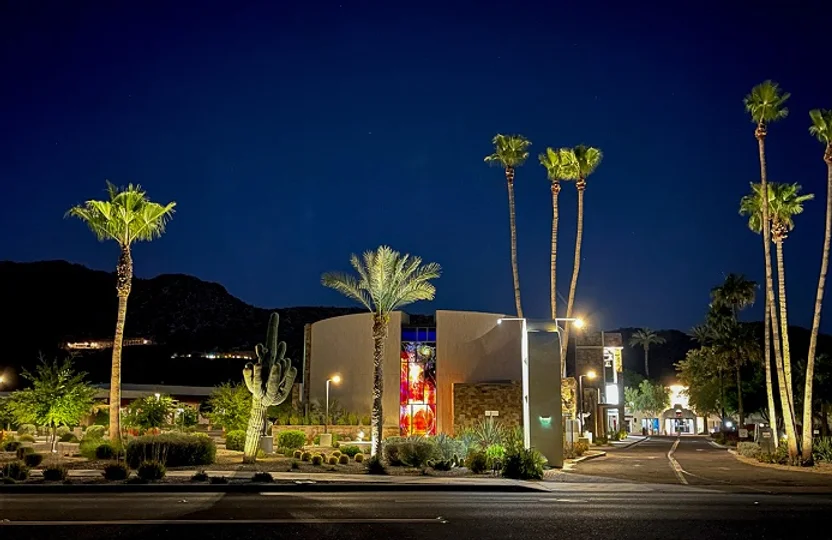
The art program written by the liturgical consultant gave me something rare — a theological framework that was not a constraint but an invitation. At its heart was a Franciscan understanding of creation as gift, relationship, and return. The building itself expressed this: a grounded masonry base giving way to a luminous upper volume, earth reaching toward heaven. The windows were conceived to live in that threshold.
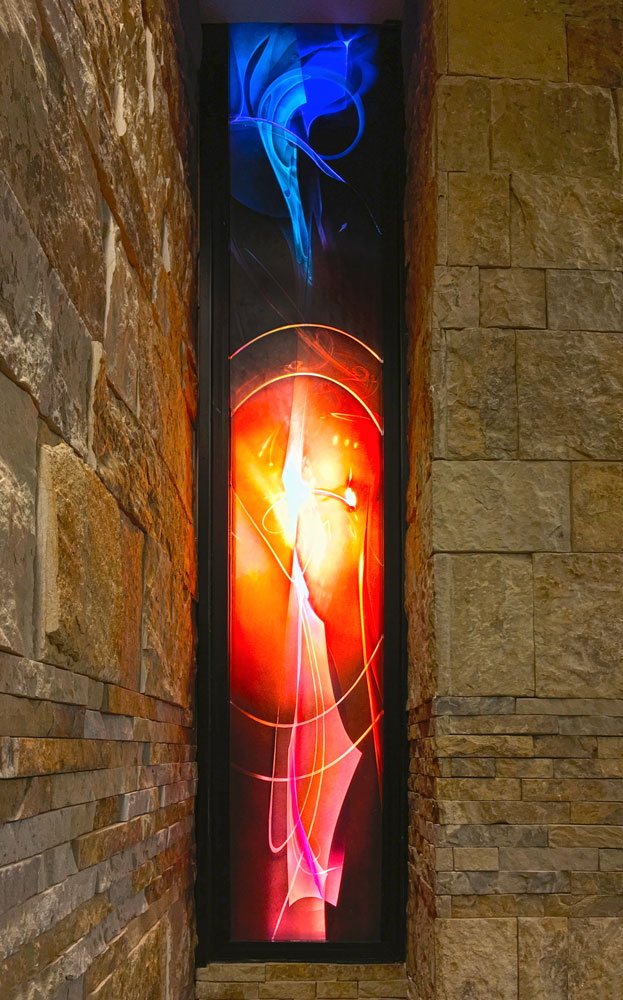
The Canticle of Creation by Saint Francis — Brother Sun, Sister Water, Brother Wind, Fire, Stars, Sister Death, Mother Earth — provided the thematic structure for the nine windows. But the program was never simply illustrative. It was cosmological. Saint Francis saw all of creation as a ladder to God, and that sense of upward movement, of everything participating in praise and return, needed to be felt in the glass.
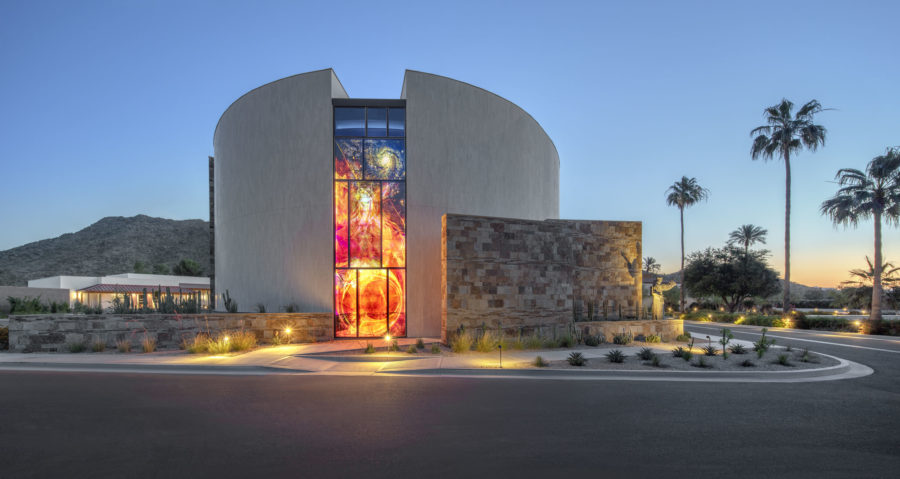
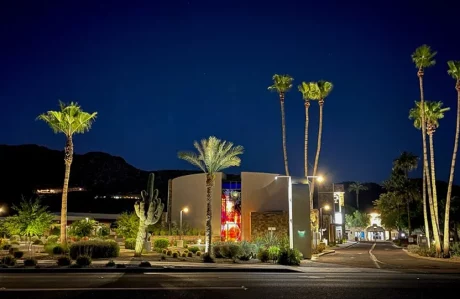
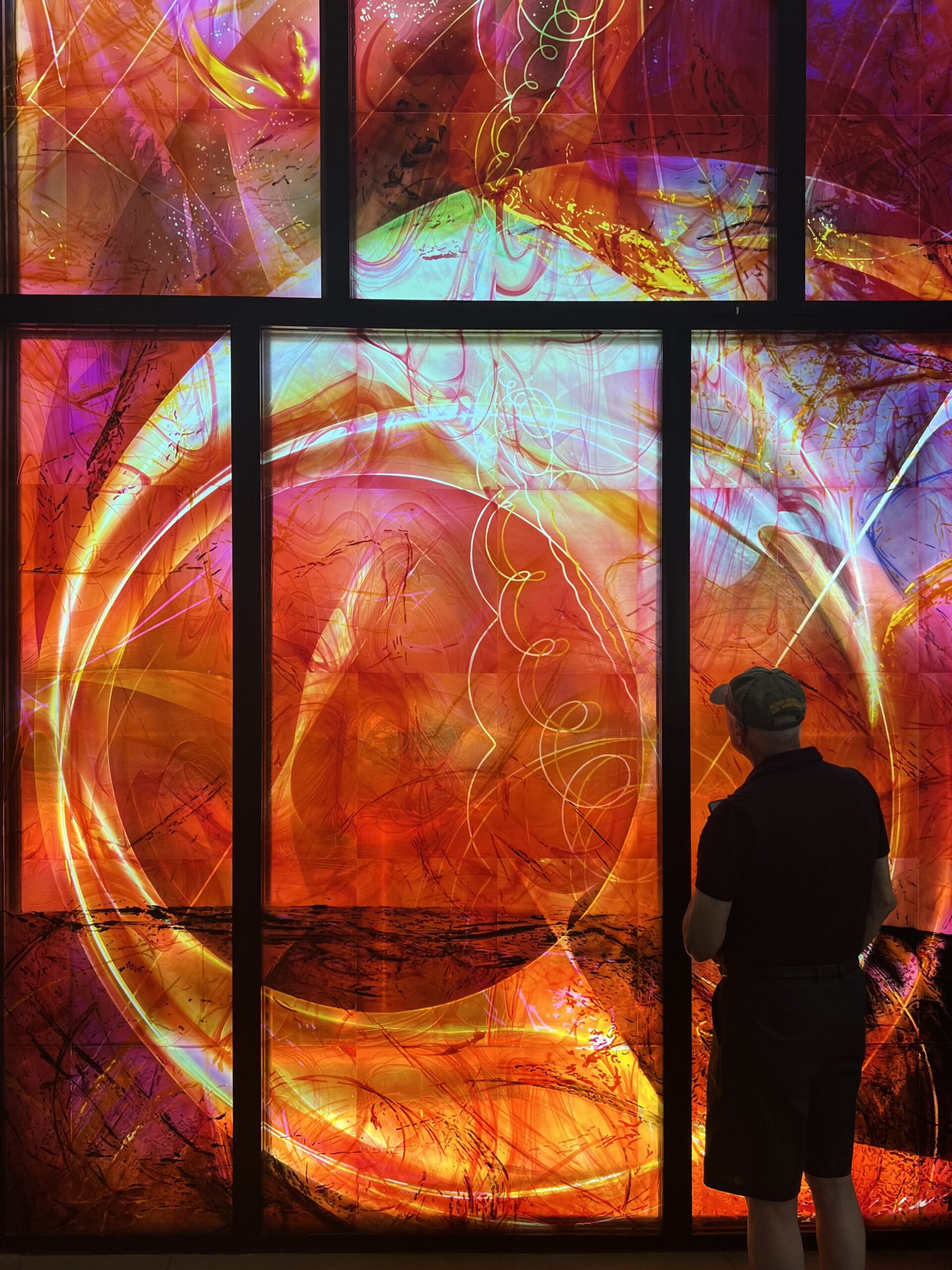
At the center of it all was the Marian window — the largest, most visible, the one that greets you as you approach the site. Mary ascending as the woman clothed in the sun, accompanied by angels, surrounded by Hubble-inspired galaxies in a swirling field of color and light. Bonaventure’s image of the circle — creation proceeding from and returning to its divine source — shaped the entire composition. It was not an illustration of a theological idea. It was an attempt to make that idea visible, luminous, present.
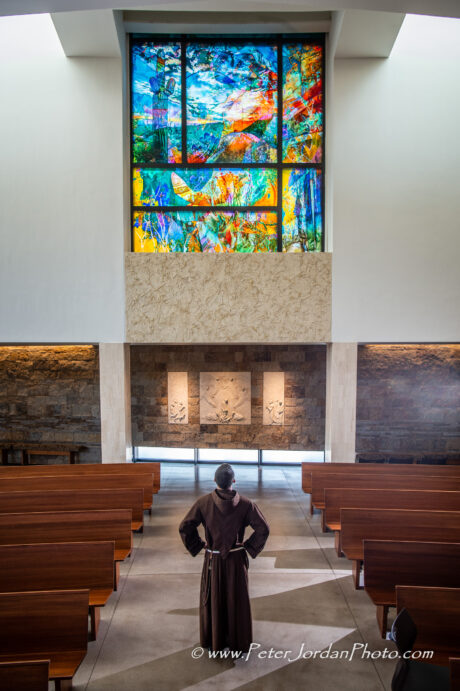
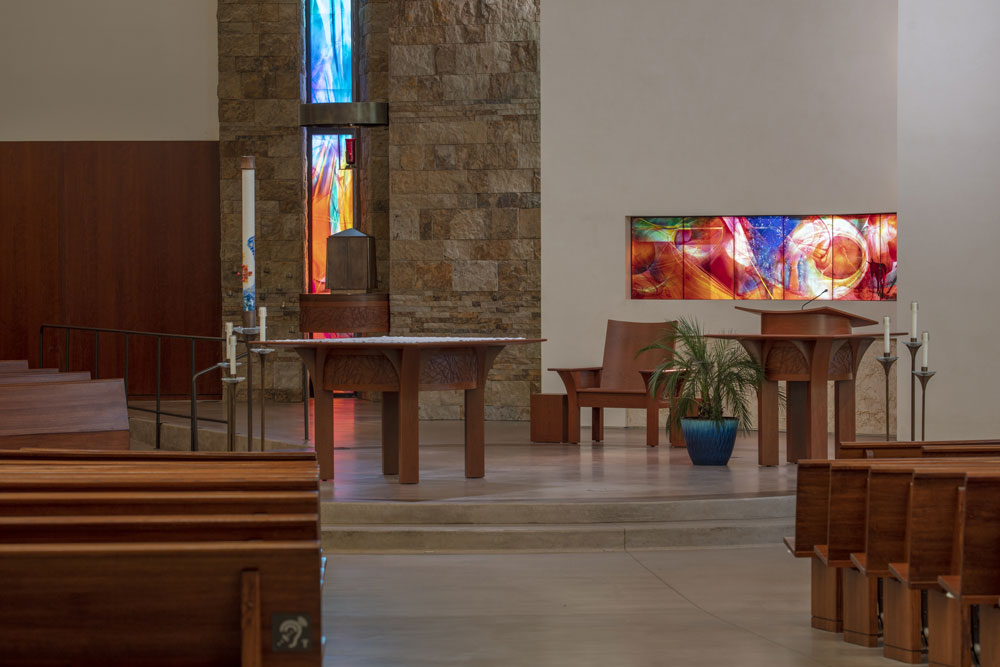
The reredos window behind the altar brought the movement back down to earth — the humility of the Incarnation, Word made flesh, the event at Greccio where Saint Francis re-enacted the Nativity and held sacred that divine descent. Ascent and humility, cosmos and manger, held together within a single unified program of light.
The Greccio Window
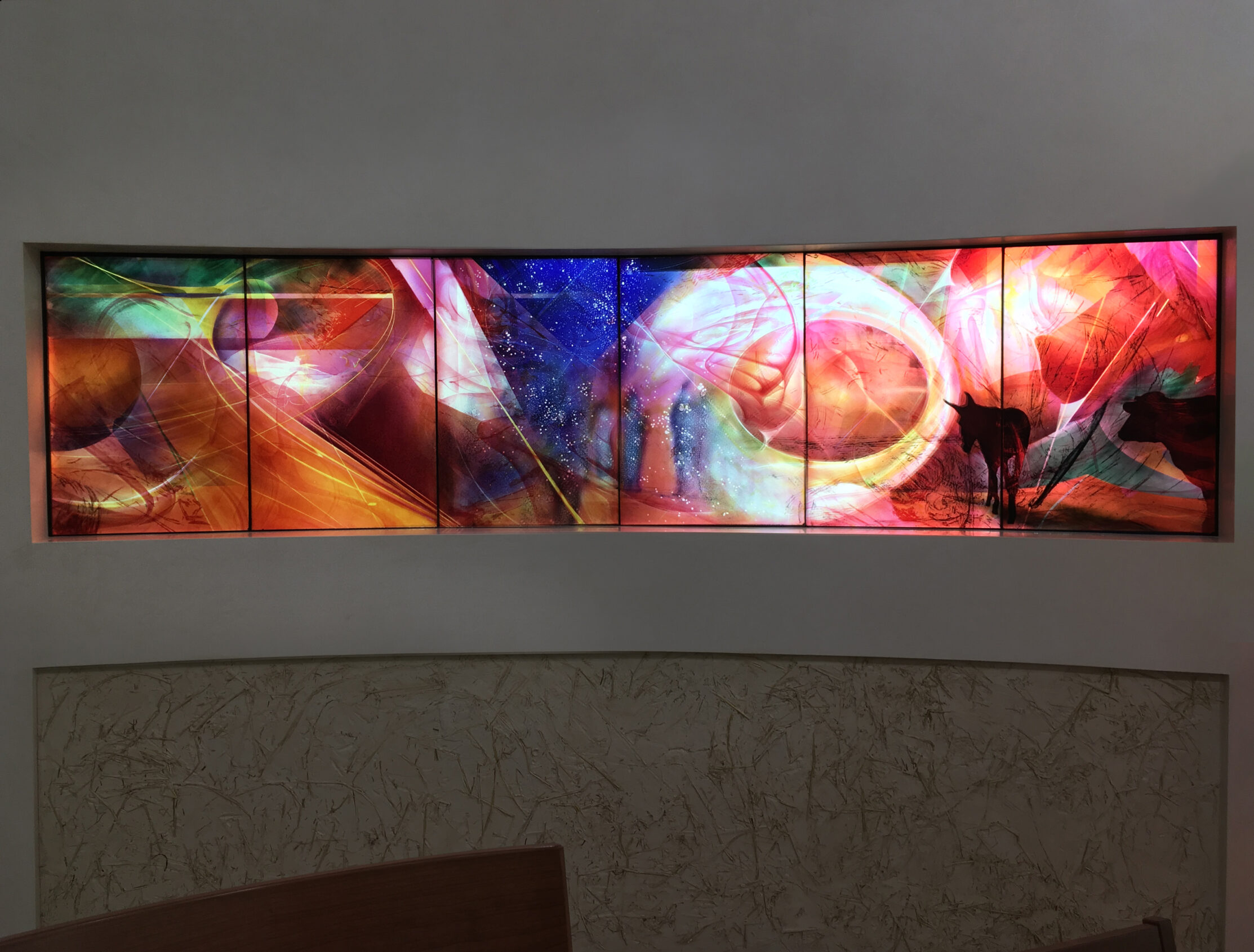
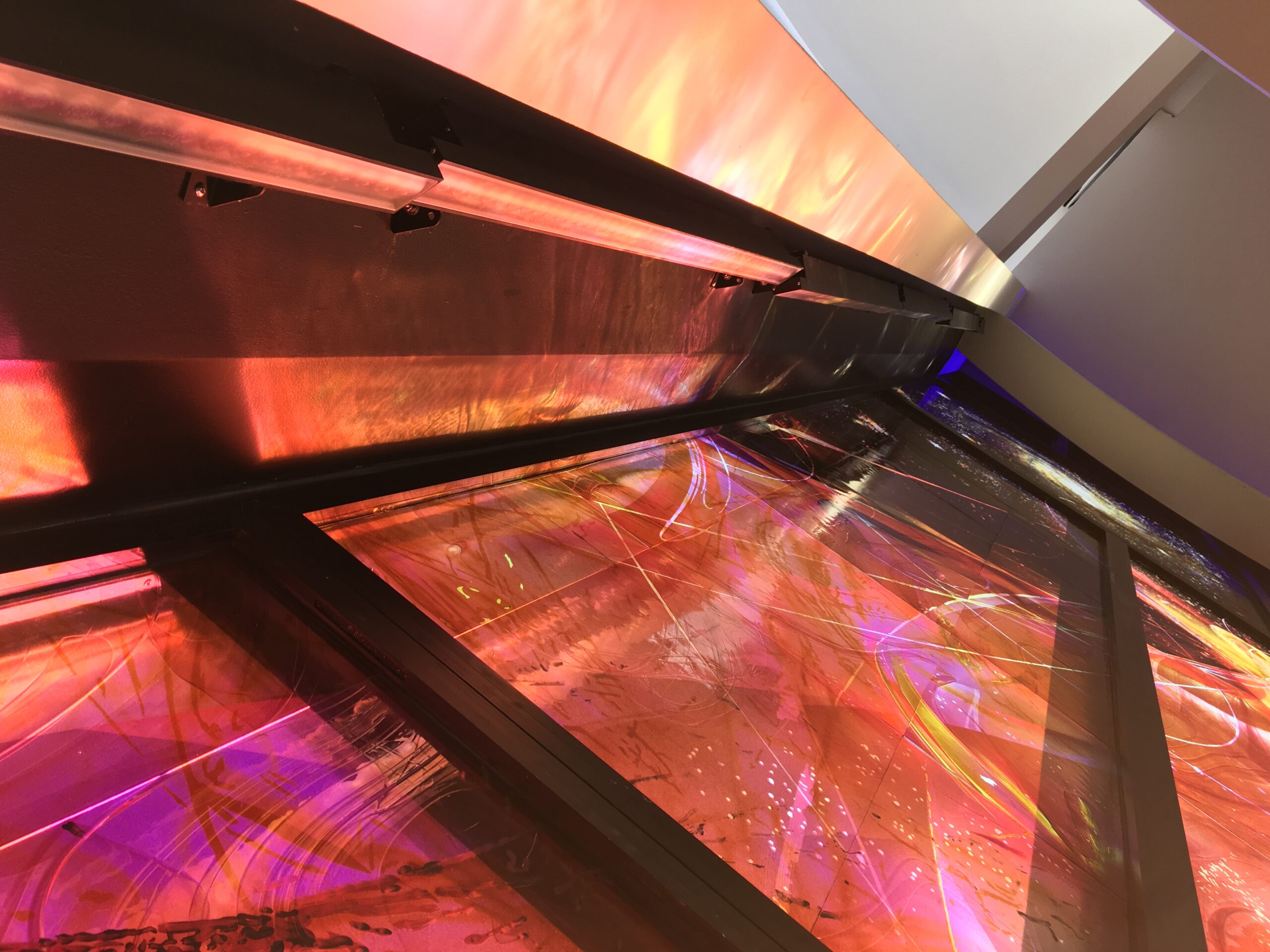
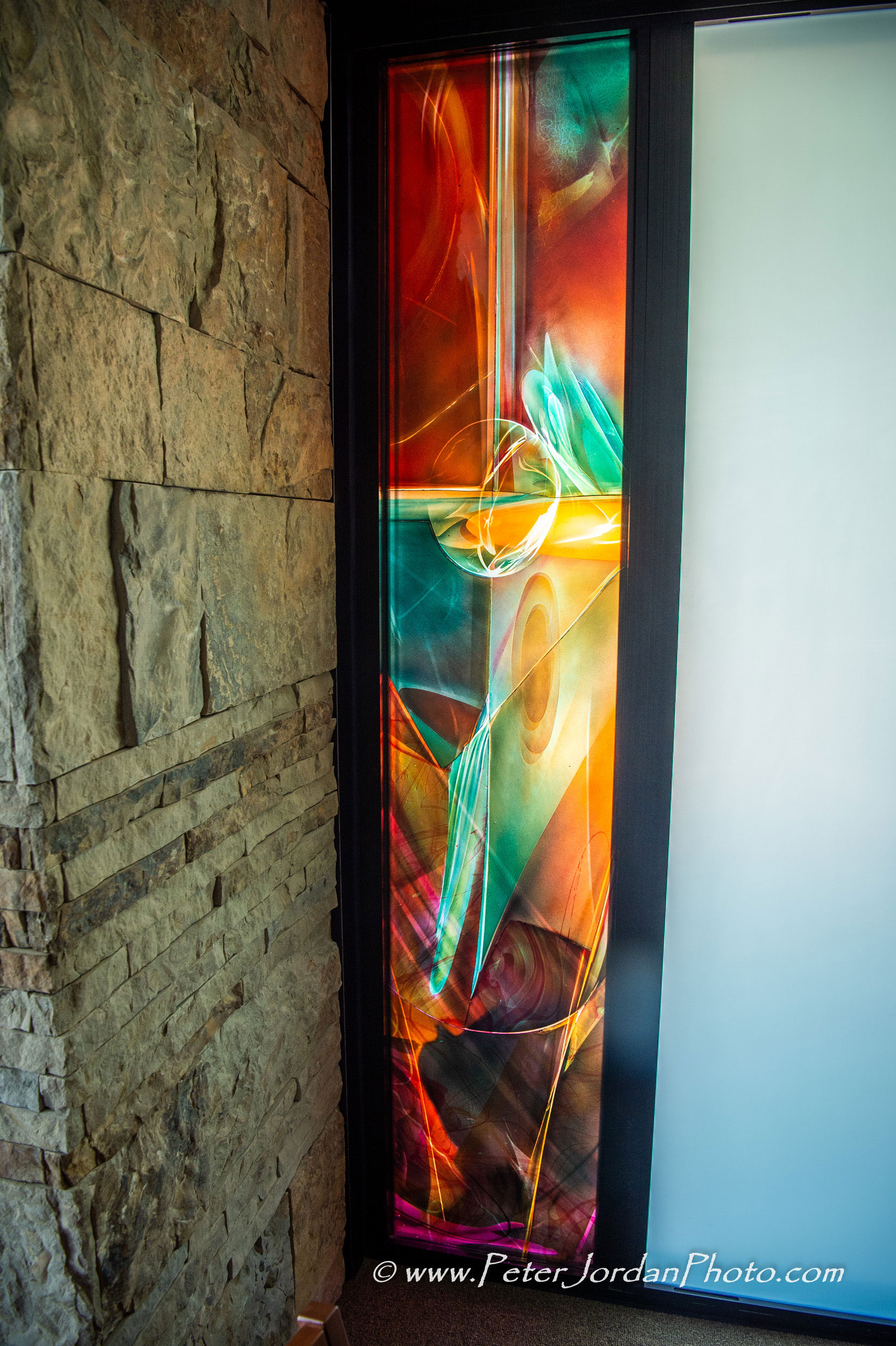
The reredos window presented a particular challenge — and became, ultimately, the most complex window I have ever designed.
What inspired me about the Greccio window, was not to do a typical nativity, but like Advent, to anticipate the coming of the Christ child. But Saint Francis didn’t re-enact the nativity to illustrate it — he re-enacted it to make it present, to feel again the strangeness and the humility of what had happened. I wanted the window to carry that same quality of anticipation. Not the arrival, but the approach. I imagined the shepherds coming down from the hills outside Bethlehem toward something they could not yet fully see — something announced to them by angels, something that had no precedent in human experience.
At the time I was reading A Wrinkle in Time to my daughters, and the idea of the tesseract stayed with me. If God became human — truly became human, in a specific place and moment in history — it had to have been like a warping of the universe. A folding of space and time around a single impossible event, unlike anything before or since. That is what I tried to make visible in the Greccio window. Not an illustration of the Incarnation but an experience of its cosmic singularity — the universe bending toward a manger.
Fabrication
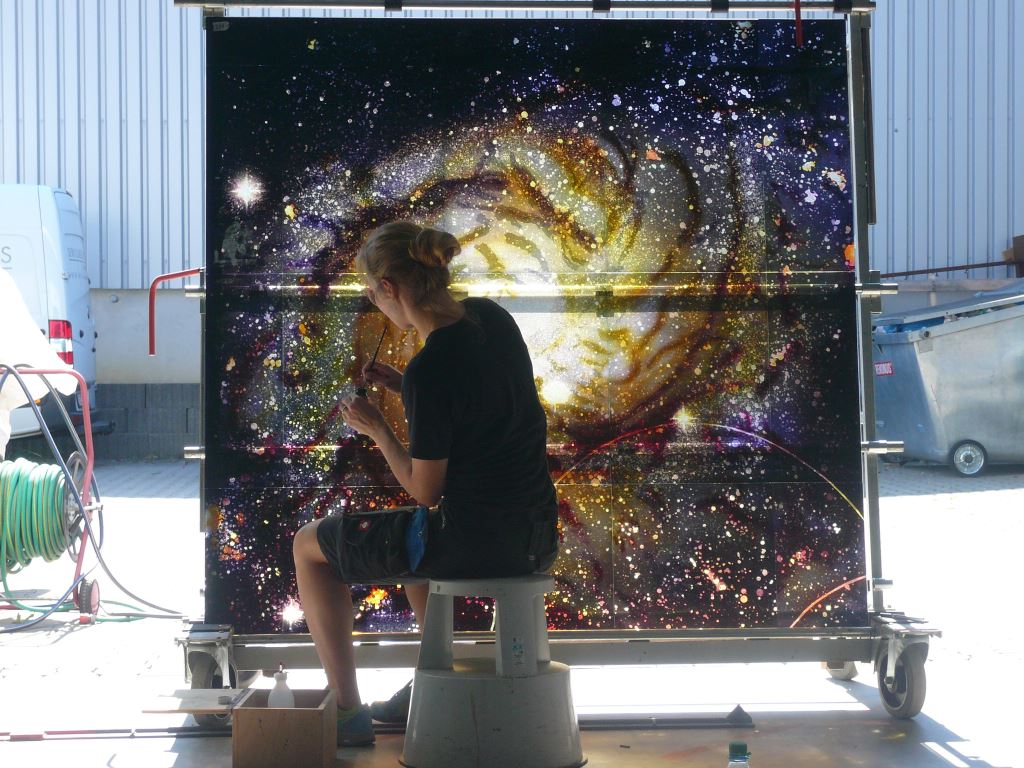
The complexity of that vision required fabrication at the highest level. My work is realized in collaboration with Derix Glasstudios in Germany — a five-generation studio whose work appears in the two largest cathedrals in Europe and in significant sacred commissions worldwide. It is a relationship built over nearly twenty years, and it shows in what is possible.
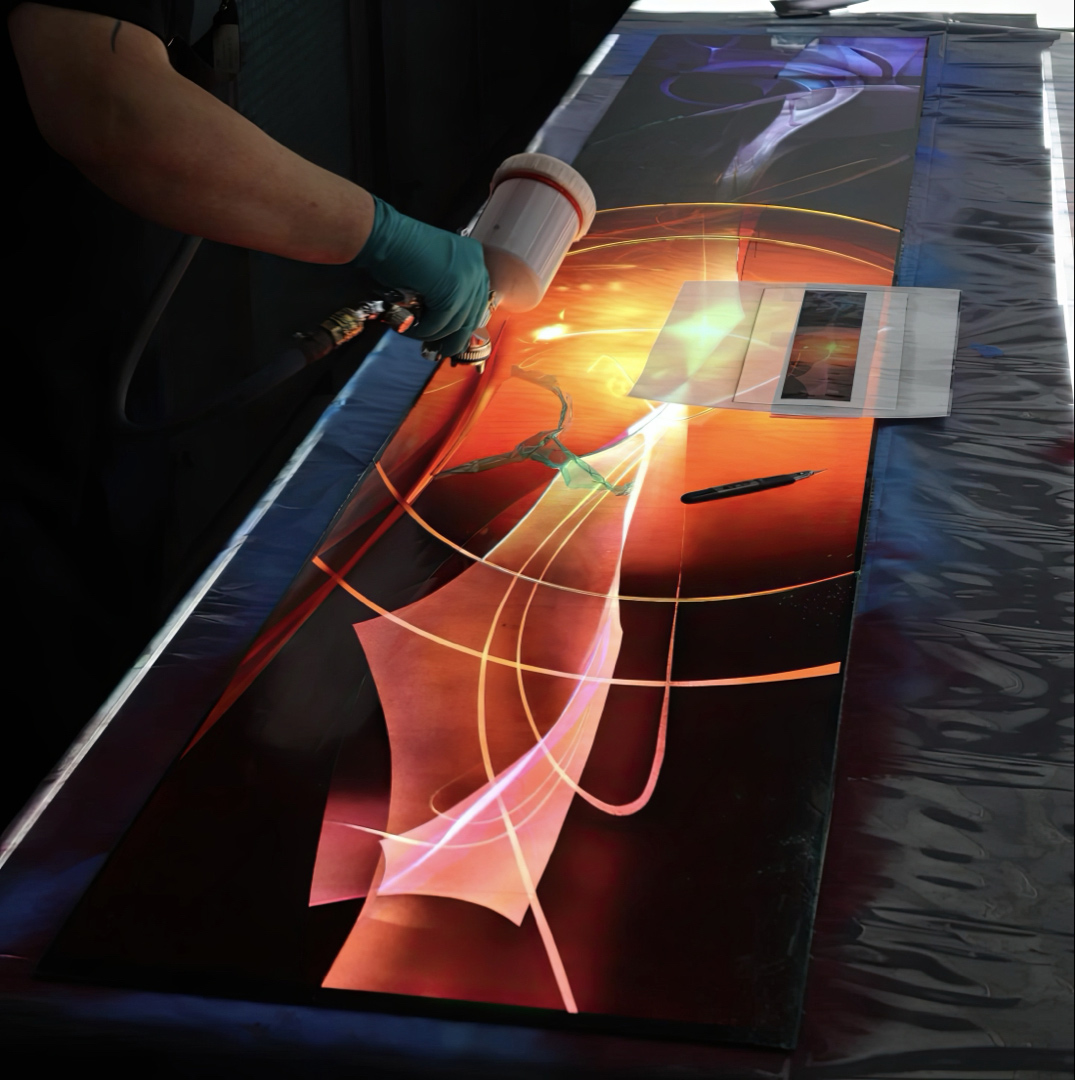
The windows are made from mouth-blown antique glass — a material and process with roots going back a thousand years. The glass techniques brought to bear on these windows span that entire history: silver staining and acid etching among the oldest, sandblasting and vitreous enamels more recent, all of them used together in a single work. The vitreous enamels are fired into the glass at high temperature, becoming molecularly one with the material — not a surface but a depth.
All of the glass is laminated to a carrier plate, without lead came. No lead lines, no interruptions in what you see. This is a contemporary approach to architectural art glass that Derix helped pioneer, and it changes everything about how the light moves through the work — unbroken, continuous, alive.
The painting throughout was carried out by Olaf Hanweg, a master glass painter at Derix whom I first worked with nearly twenty years ago on an earlier commission. That relationship has continued ever since — through project after project, each one building a deeper understanding of how I think and what the work is reaching for. He knows when to follow the design precisely and when to bring his own judgment to bear. Each window passes through multiple firings, building the surface layer by layer, until the light lives inside the glass the way it needs to.
A number of committee members traveled to Germany during fabrication to see the work in progress — to stand in the studio and witness the windows taking shape before they had ever seen the inside of their church. It was the kind of investment in the work, and in one another, that you don’t forget.
The Completed Work
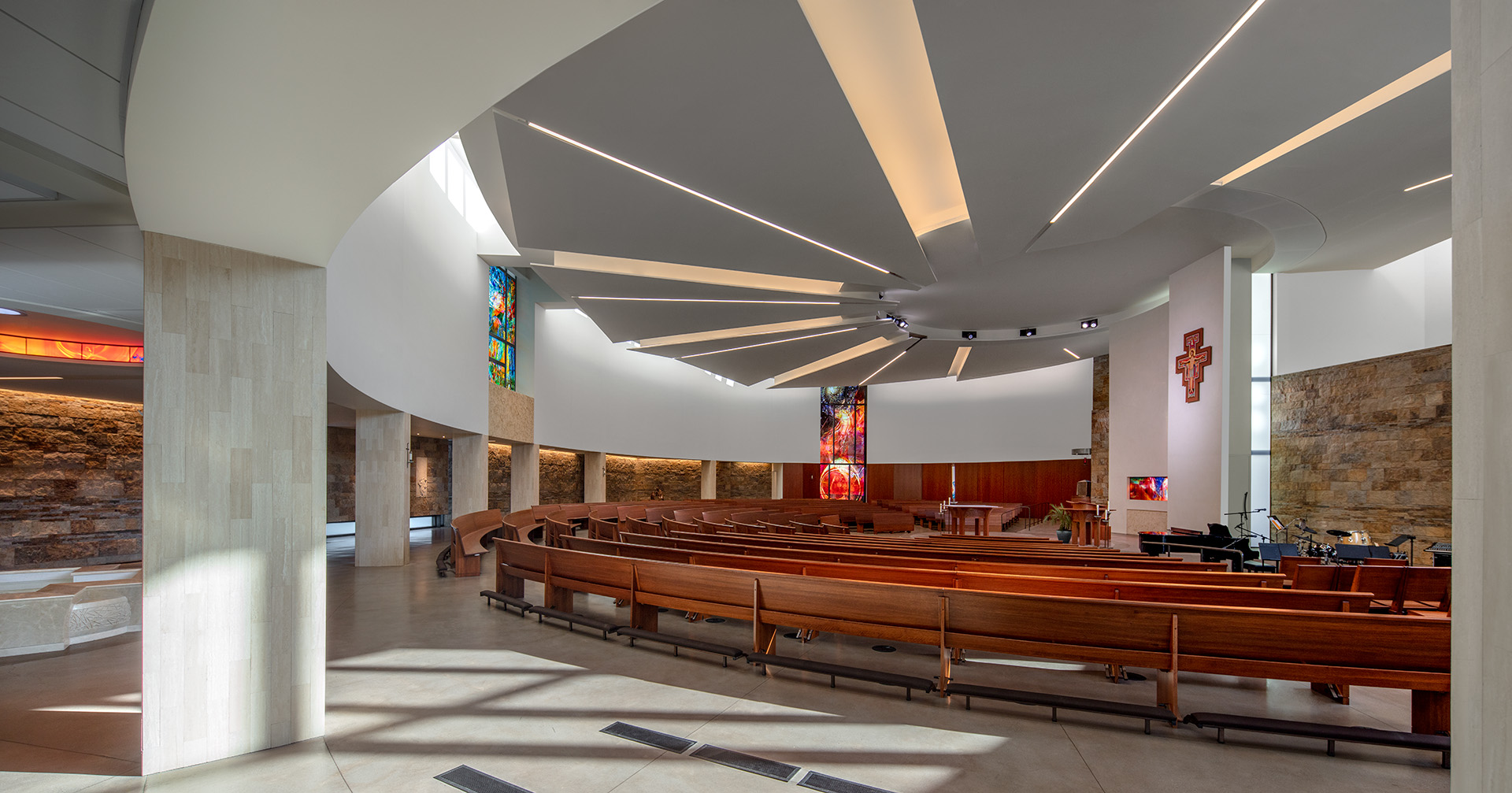
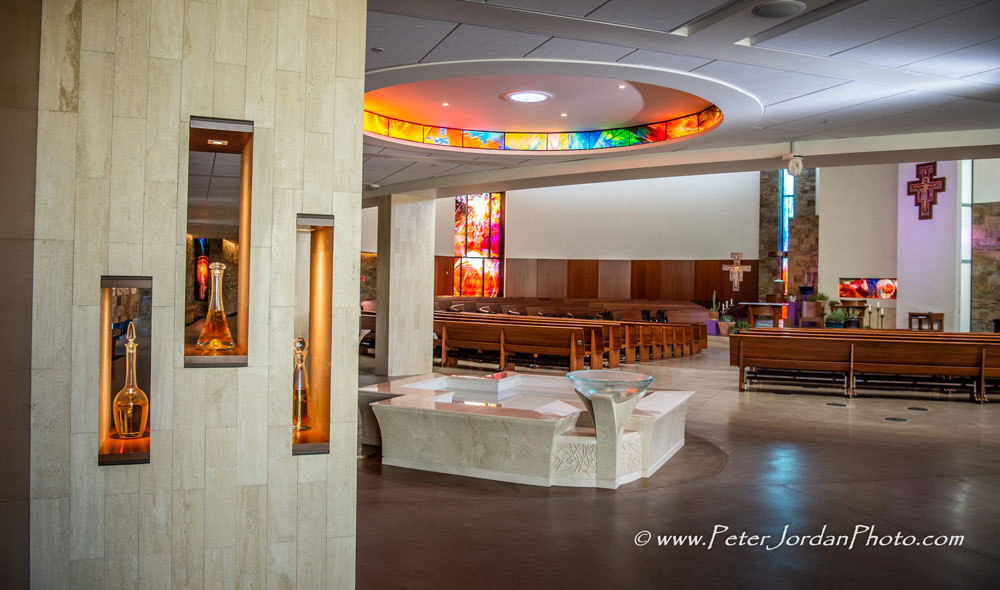
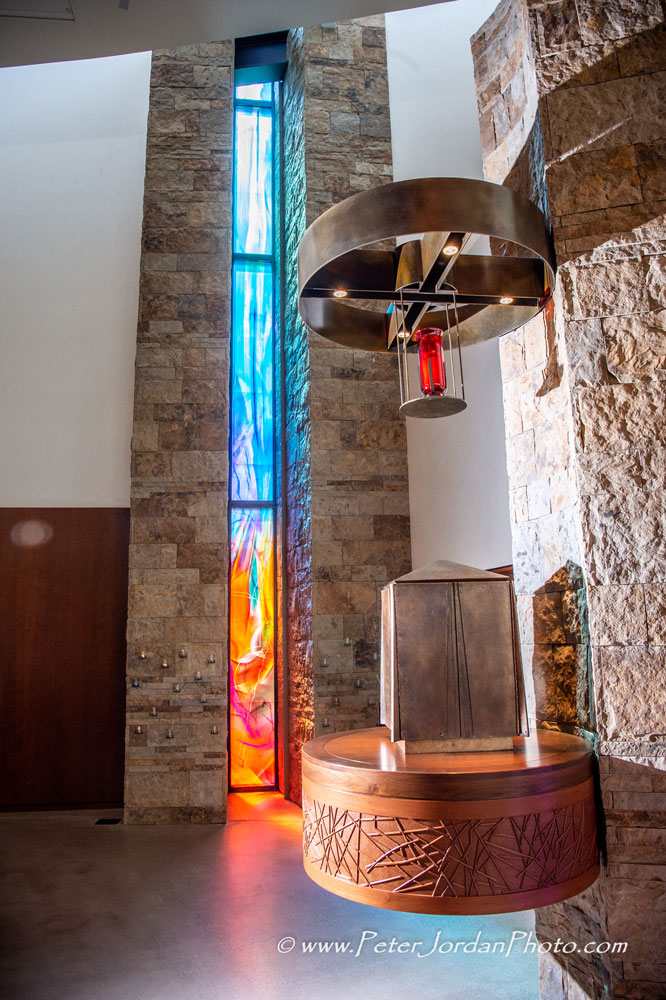
When the windows were installed and the church received its light for the first time, what became clear was that the nine windows were never really nine windows. They are one continuous environment — the Canticle of Creation unfolding across the whole of the space, from the Marian window visible at the entrance to the cosmic humility of the Greccio reredos, from Brother Sun and Sister Water to Sister Death, each window in conversation with the others, all of them gathered within a single field of light and praise.
The sacramental axis the liturgical consultant had envisioned — from baptism through Eucharist to the reserved Blessed Sacrament — is held and accompanied by the glass throughout. Light in this space is not atmospheric. It is sacramental. It moves with the community through the rhythms of the liturgy and the hours of the day, projecting color across walls and floors, extending the presence of the windows into the life of the building in ways that shift and deepen over time.
For the dedication, the Franciscan Renewal Center flew Olaf Hanweg and his colleague from Germany to Arizona to be present for the blessing of the church. That gesture said everything about how this community understood what had been made for them — not as a product delivered, but as a gift given by people who had poured themselves into it.
This is what stained glass can be when the collaboration is right — when the theology is alive, when the community knows what it believes and is willing to trust an artist to make it visible. The silence in the room when the Marian window was first revealed, the tears when Sister Death was shown — those were not responses to a design. They were recognition. The community saw something they had always known but had not yet seen.
Recognition
The project received a number of significant awards following its completion, including the CODAawards Merit Winner and Top 100 in 2023, and Honor Awards from Faith & Form and the Interfaith Forum on Religion, Art, and Architecture in 2018 and 2019.
I am truly grateful for the recognition this work has received. The role of the artist, though, is to be open, and to create work that remains open — open enough to live in the faith and lives of those who gather in that space year after year. That, if it happens, is a gift of the Spirit.
A Note on Cost
Stained glass at this level is a significant investment. The materials are expensive, the fabrication is exacting, and the process — from first conversation to installed glass — requires time, skill, and collaboration across multiple disciplines. The glass itself is fabricated at Derix Glasstudios in Germany — a five-generation studio working at the highest level of the craft anywhere in the world. What I can offer alongside that is complete transparency from the outset. Every project receives a detailed quote that accounts for every aspect of the work. I have never added charges beyond an accepted quote.
For many parishes, the fundraising visuals developed during design — renderings, animations, presentation materials that show the windows as they will appear in the finished space — have proven to be among the most effective tools for a capital campaign. At Our Lady of the Angels, a single donor saw the digital rendering of the Marian window and funded the entire window based on that image alone. In another case, one panel of the Sister Earth window was completed and installed. A donor saw it in the space, understood immediately what the full program could be, and funded all the remaining panels. The work has a way of inspiring generosity in people who encounter it — even before it is finished.
Planning a New Church or Renovation?