Our Lady of Loreto
2016
·
Foxfield, Colorado
Sector
Liturgical Art
Client
Our Lady of Loreto Parish
Architect
David Owen Tryba Architects
+ Awards
+ Credits

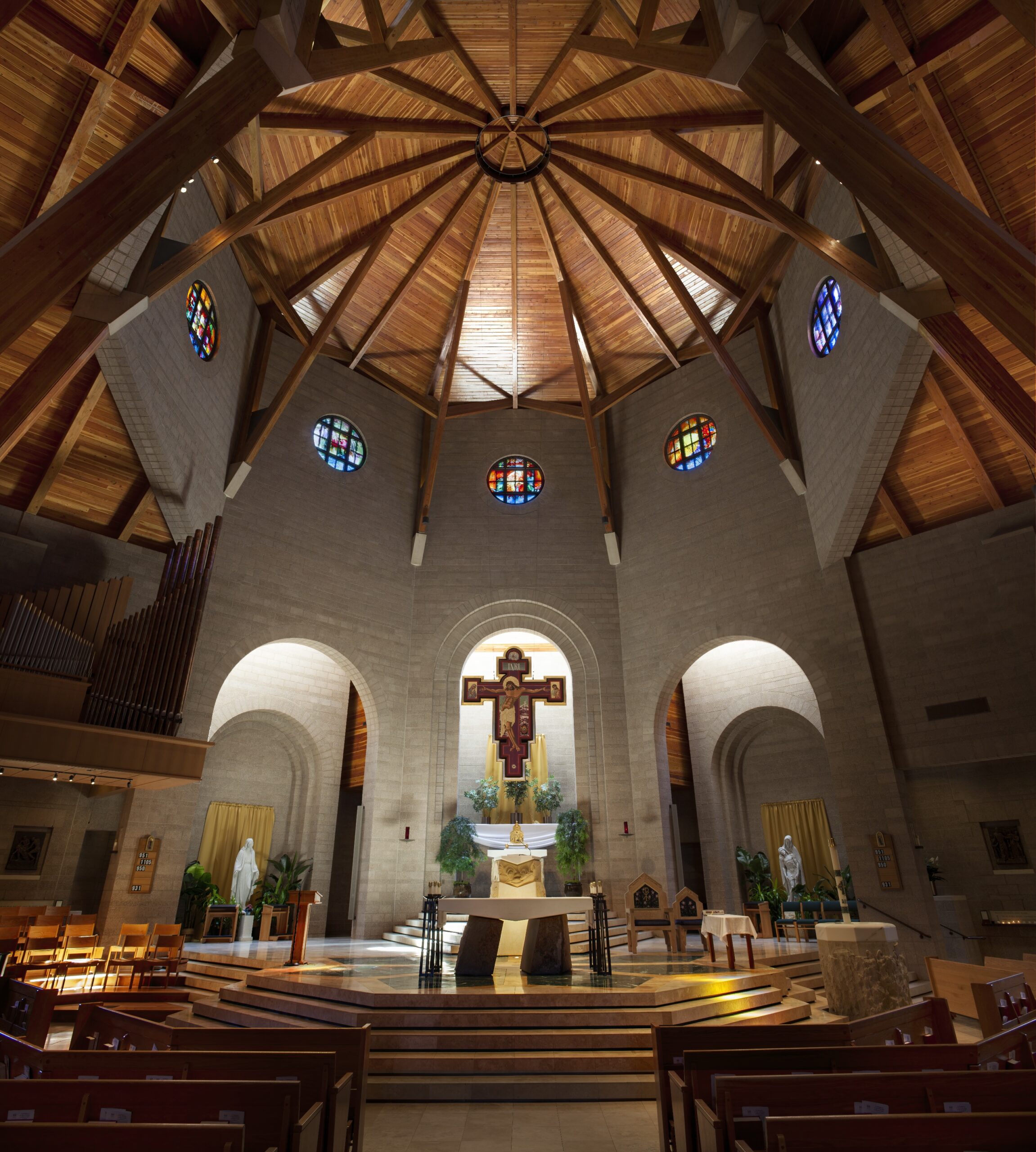
This project brings together twenty-six stained glass windows for Our Lady of Loreto Parish in Foxfield, Colorado — a comprehensive program developed in close dialogue with the architecture, and with Msgr. Edward Buelt, whose collaboration was central to the work’s theological depth. The windows were blessed during the celebration of Mass in 2014 and 2016, and received Design Awards in Religious Art from
Faith & Form
Magazine and IFRAA in both years. The church sits on an elevated site east of Denver, inspired by the Romanesque Basilica of St. Ambrose in Milan, with a spectacular view of the snow-capped Rocky Mountain front range to the west. Within the sanctuary, pillars of wooden columns evoke the tall-standing cedars of Lebanon referred to in the Psalms.
The installation is organized through three interrelated series: the Mysteries of the Rosary, the Angelic Hierarchy, and the Celestial Jerusalem. Together they form a layered framework that moves between narrative, cosmology, and vision — allowing the windows to be encountered both individually and as a unified whole unfolding through movement, time, and the rhythms of worship.
The Mysteries of the Rosary
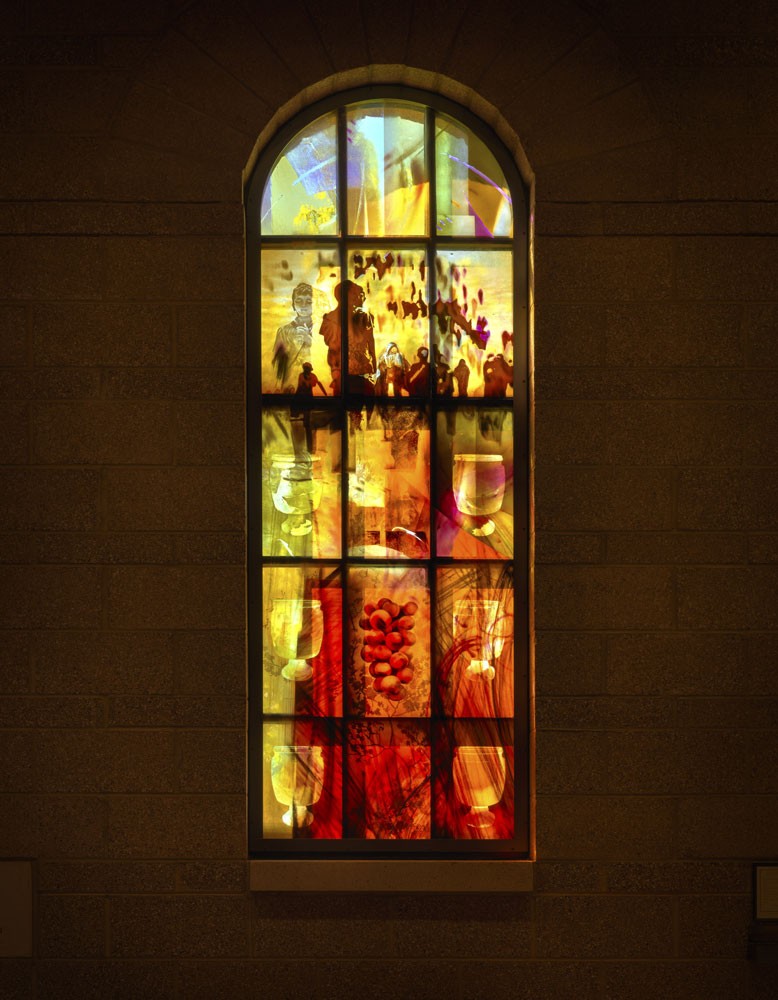
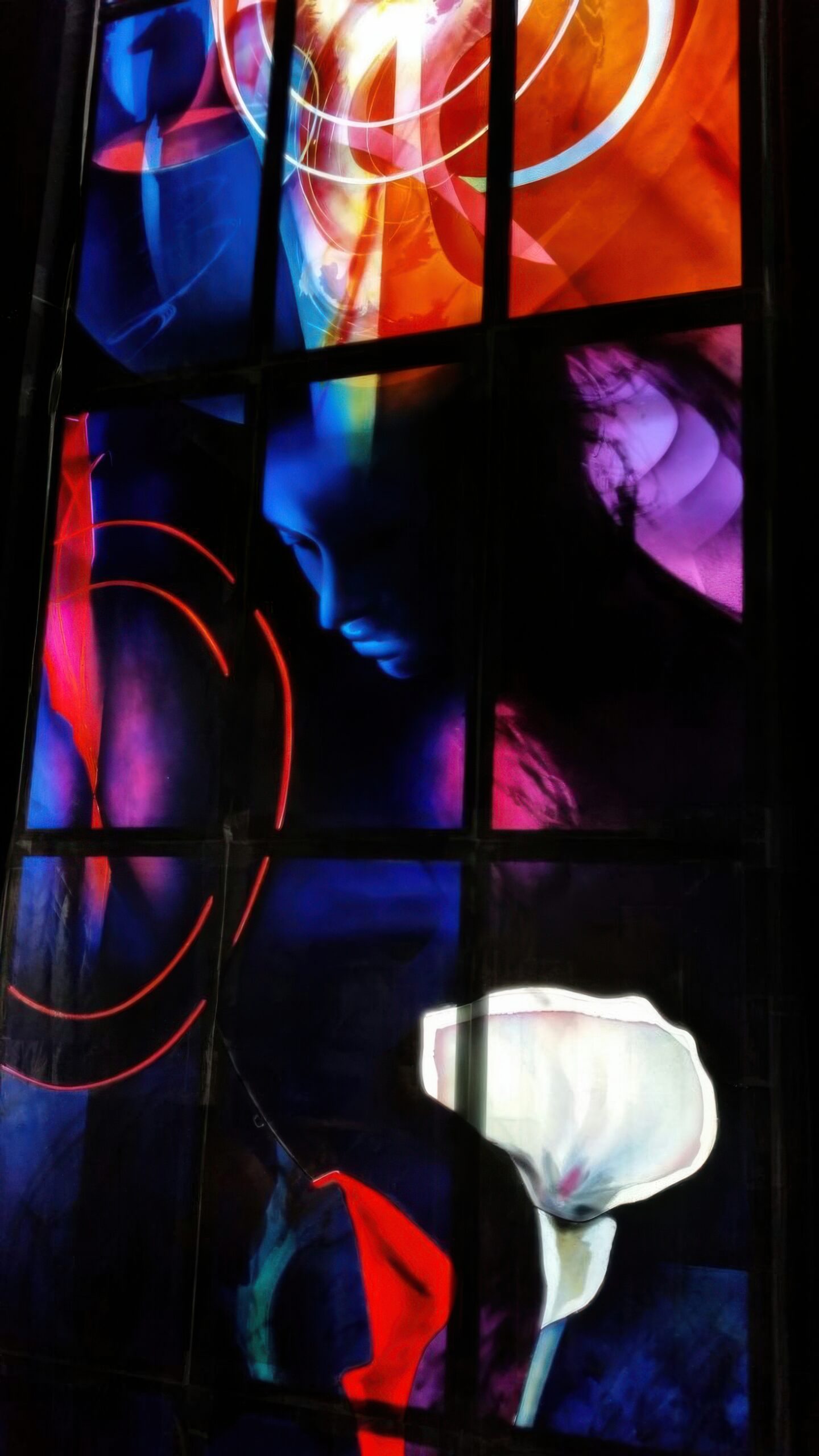
The Mysteries of the Rosary are portrayed in ten semi-circular aisle windows along two arcades at ground level. From north to south, the mysteries are grouped according to Pope Pius V of the 16th century: the Sorrowful, the Glorious, and the Joyful Mysteries; the Luminous Mysteries, added by Saint John Paul II in 2002, complete the cycle. The principal design element in each window explores the relationship between light and darkness — especially fire and Spirit.
The Baptism of Christ window draws on St. Ephrem’s
Hymns on Faith
:
“Fire and Spirit are in the womb of her who bore you. Fire and Spirit are in the river in which you were baptized. Fire and Spirit are in our baptism, and in the Bread and Cup is Fire and Holy Spirit.”
And St. Justin in
Dialogue with Trypho
:
“As Jesus went down into the water, the Jordan was set ablaze.”
And Matthew 3:11:
“He will baptize you with the Holy Spirit and fire.”
At the blessing of these windows, a parishioner said to me:
“This was a holy place, now it’s a sacred place.”
It is my hope that these windows do indeed help make Our Lady of Loreto a sacred place in which to prayerfully contemplate and liturgically respond in community to the work of God in our lives. For as Romano Guardini wrote:
“The rosary is not a road, but a place, and it has no goal but depth. To linger in it has great compensations.”
The Angelic Hierarchy
The nine clerestory windows depict the nine ranks of the angelic hierarchy, paired with the Medieval celestial hierarchy. Each rank of angel corresponds to a celestial body of light, whose illumination was understood to produce a specific metal when its light touched the earth. The Moon produces silver — hence the golden, amber yellow of the Angel window, created by firing silver nitrate onto the glass. Mars produces iron — hence the greens and browns of the Virtues window, produced by melting iron into the kiln. Venus is associated with copper and the rank of Principalities — hence the blue, green, and red that result from firing copper.
Msgr. Buelt stated in the
Catholic Register
:
“We were very concerned to follow the ancient tradition and theology of the Church, and in particular Pseudo-Dionysius, the most quoted Church Father in St. Thomas’ Summa Theologica.”
St. Thomas cautioned against representing angels in human form. Pseudo-Dionysius taught that one should
“depict the celestial beings from fire, showing their Godlikeness.”
Closest to the Throne are the Seraphim — the Burning Ones — and all the properties of fire speak of them: energy, heat, light, illumination, the capacity to consume.
The first clerestory window to the northeast is the Prince of Angels, St. Michael, the defender of the church, pointing his protective sword to the west.
Cardinal James Francis Stafford wrote of these windows:
“The breath of God’s creation of man is a particular signal contained in blown glass… His windows recall the ruah of God, ‘the wind, the breath, the spirit’ of God sweeping over the waters in Genesis 1. Parsons has unfolded visibly the drama of the freedom of a loving Creator.”
The Celestial Jerusalem
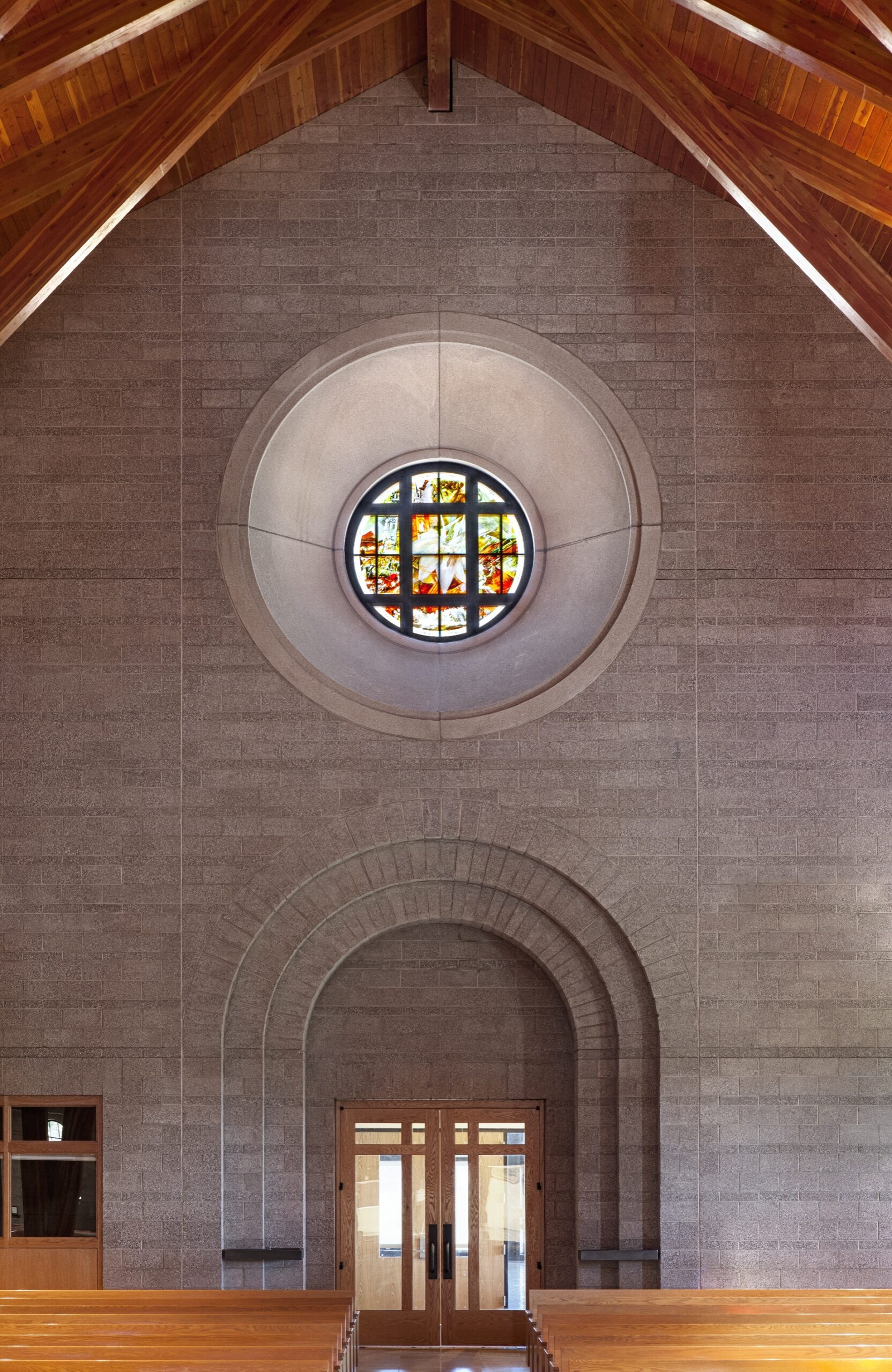
Beneath the Romanesque octagonal dome are five large round windows inspired by the New Jerusalem described in Revelation. The most prominent, aligned with the center aisle above the tabernacle, depicts Christ the Lamb of God seated on His throne. The other four represent the four seasons and the fruits of the Tree of Life throughout the year, aligned to the annual passage of the sun from north to south. The River of Life flows from the bottom of each window, recalling Amos 5:24:
“But let justice roll down like waters, and righteousness like an ever-flowing stream.”
The Wedding Window
Set to the northeast, the final rose window presents the celestial church of Denver to her divine bridegroom. When an angel takes Saint John of Patmos to a great and high mountain to see the bride of Christ in Revelation 21, I imagined where else this could be but Denver seen from Red Rocks Amphitheatre. Between the Easter sunrise services at Red Rocks and the Christmas Eve midnight mass at the Basilica of the Immaculate Conception, these are among my fondest and most sacred memories of Colorado — and both are shown in this window.
A Columbine and angel blow their trumpet, the Columbine being an ancient symbol for the Holy Spirit. I was deeply moved by the role of Our Lady of Loreto in attending to those affected by the Aurora movie theatre tragedy, and how sadly the word Columbine now evokes another Colorado tragedy, very close to where I grew up. I felt this window should say something about light — and how light can overcome darkness. Hope-filled, golden-yellow, and eternal.
The Making
The work begins, as all my work does, in watercolor — fluid studies in which transparency, layering, and gesture guide the development of form. These qualities are carried into the glass through acid etching, sandblasting, and vitreous enamels, realized with Derix Glasstudios and master glass painter Olaf Hanweg, using hand-blown glass from Lamberts Glashütte in Waldsassen, Germany. The panels were laminated to float carrier pieces, painted, sandblasted, fired, and tempered — each through two or more kiln firings to build the voluminous depth one feels when looking into these windows.
Breath, wind, fire, and water — all required for the very process of making glass — are also the imagery throughout. Process and meaning are the same thing here.






Begin a Conversation